Individual Cognitive Stimulation Improves Cognition, Mood, and Prefrontal Activation in Mild Neurocognitive Disorder
In a single-blind RCT (n=36), a 12-week individual cognitive stimulation program (24 sessions) improved global cognition (MMSE) and executive function (FAB) and reduced depressive symptoms versus usual activities. fNIRS showed increased oxygenation/efficiency mainly in lateral prefrontal regions after the intervention, with high adherence.
KenyP
5/8/20242 min read
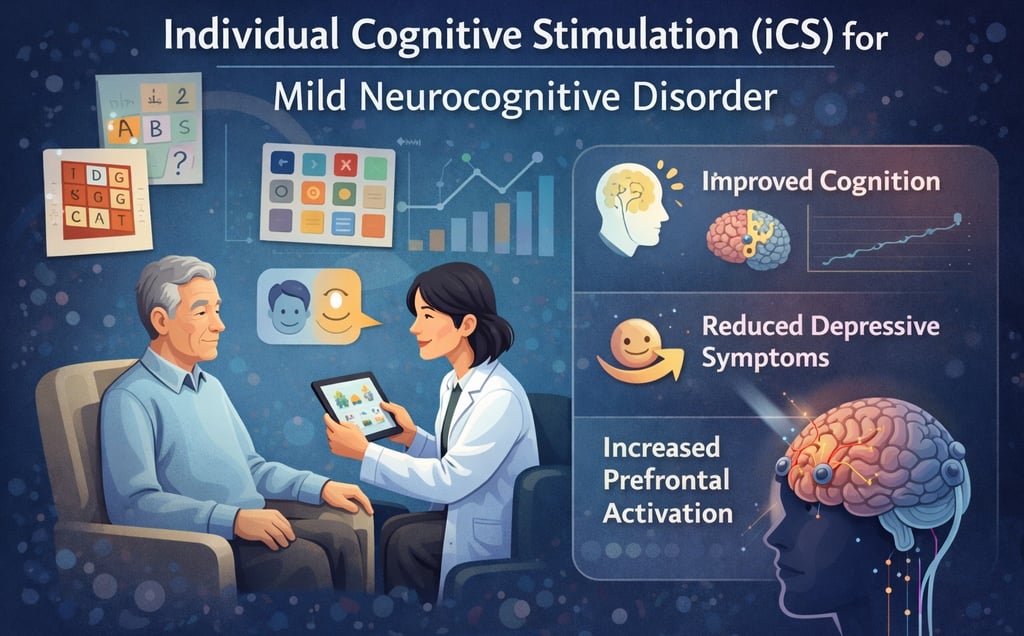
This paper evaluates whether an individual cognitive stimulation (iCS) program can benefit older adults diagnosed with mild neurocognitive disorder (mild NCD)—a stage marked by measurable cognitive decline that typically does not yet compromise basic daily independence. The authors highlight the growing prevalence of neurocognitive disorders with aging and the importance of non-pharmacological interventions to preserve cognitive function and emotional well-being.
The study used a single-blind, randomized, parallel two-arm design (iCS vs. usual activities) and registered the trial (NCT04693611). A total of 36 participants were randomized (18 intervention, 18 control). The intervention consisted of 24 one-to-one sessions over 12 weeks (twice weekly), each ~45 minutes, delivered by a trained therapist. Sessions followed a structured flow (welcome, orientation, main cognitive tasks, review) and were individualized in difficulty and varied in content; the program targeted multiple domains (e.g., attention, memory, language, executive functions) and was adapted to a digital format during the pandemic.
Outcomes were assessed at baseline and endpoint and included global cognition (MMSE), executive functioning (Frontal Assessment Battery—FAB and subtests), and mood (GDS-15). Additionally, the intervention group underwent fNIRS to examine prefrontal hemodynamic changes pre/post intervention, focusing on regions of interest across the prefrontal cortex.
Results showed significant Group × Time effects favoring iCS. The intervention group improved in MMSE and FAB total score relative to controls, and depressive symptoms decreased in the intervention group compared to controls. fNIRS findings suggested increased oxygenation/activation in lateral prefrontal areas (LPFC/RPFC) after iCS, interpreted as enhanced activation or functional efficiency, while medial regions showed less change. Adherence and collaboration were reported as very high.
The authors note limitations such as the use of brief screening tools (e.g., MMSE rather than more extensive batteries) and lack of follow-up, and they call for larger, more diverse samples to strengthen generalizability.
Conclusions
Clinical relevance: A structured, individualized cognitive stimulation protocol may offer dual benefits—supporting both cognitive performance (especially executive function) and mood—in older adults with mild NCD.
Mechanistic insight: fNIRS changes in lateral prefrontal cortex oxygenation provide a plausible neurophysiological correlate for observed improvements, suggesting iCS may promote more efficient recruitment of executive-control networks.
Mental health implications: The reduction in depressive symptoms indicates iCS could be a valuable adjunct in psychosocial care for mild NCD—potentially improving emotional well-being while also engaging cognition through meaningful, guided activity.
Next steps: Future studies should include longer-term follow-up, broader cognitive assessment, and replication in larger samples to clarify durability, optimal dosing, and which patient profiles benefit most
Neuropsychological support to overcome cognitive challenges
(btw.id): NL005156570B11 KVK: 95491236
© 2025. All rights reserved.