The Five Principles of Good Sleep Health: A Practical Framework Beyond Sleep Hygiene
This article proposes five evidence-based principles to promote sleep health—Value, Prioritise, Personalise, Trust, and Protect sleep—designed for public engagement and as a first-line self-help approach for poor sleep or mild insomnia. Developed for the UK NHS “Every Mind Matters” campaign, it complements (but does not replace) CBT for chronic insomnia and calls for formal evaluation.
KenyP
5/8/20242 min read
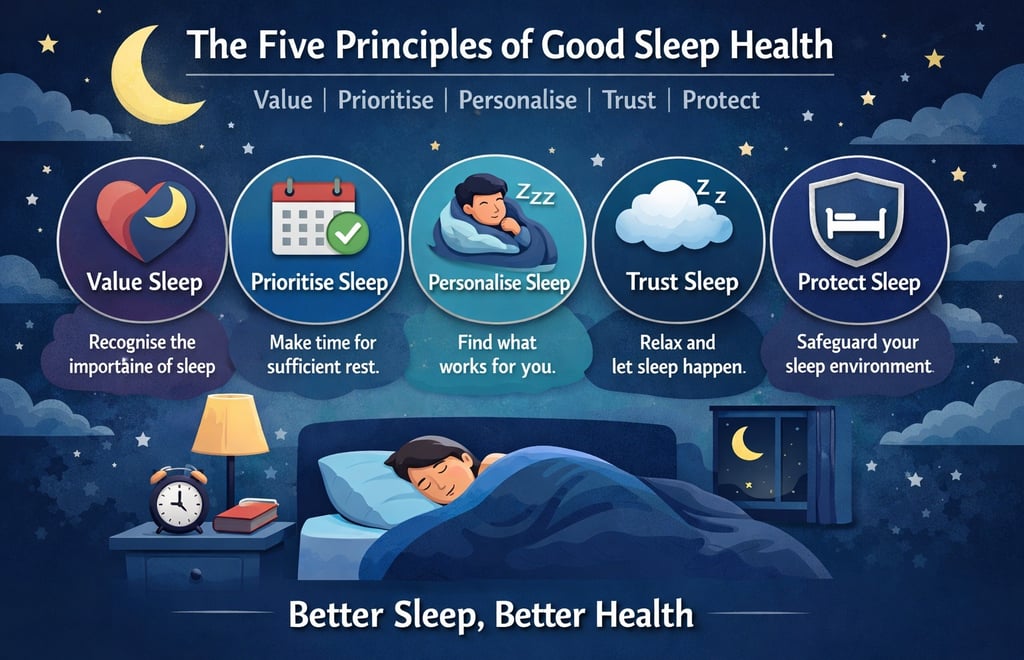
The article presents a simple, public-facing framework called the “5 Principles of Good Sleep Health”—Value, Prioritise, Personalise, Trust, and Protect sleep—created to help people engage with sleep as a core health behavior, not just a set of “sleep hygiene” tips. It was developed for the UK NHS “Every Mind Matters” campaign (2020) to support self-management of poor sleep and mild insomnia symptoms, especially in the general population where needs and circumstances vary widely.
Rather than focusing only on common advice (e.g., caffeine, screens, bedroom temperature), the principles aim to shape a sleep mindset and lifestyle that is practical and supportive, while acknowledging that sleep can be influenced by stress, work schedules, health conditions, and life events. The author emphasizes that these principles are not a replacement for CBT-I (cognitive behavioral therapy for insomnia), which remains the guideline-recommended treatment for chronic insomnia, but they can bridge a gap by offering a clear first step for many people.
What each principle means (in plain terms)
Value sleep: Treat sleep as a biological necessity, not optional “downtime.” If you don’t truly value it, you’ll keep sacrificing it when life gets busy.
Prioritise sleep: Convert intention into behavior—plan and protect time for sleep the same way you would for work or exercise.
Personalise sleep: Learn what works for you (timing, routine, duration). The article highlights trial-and-error to find your best sleep window within a realistic range.
Trust sleep: Build confidence in your body’s natural sleep system—worrying and “trying hard” to sleep often backfires, so the goal is a calmer, trusting approach.
Protect sleep: Once you find what works, defend it—set boundaries and reduce avoidable disruptions (social, environmental, behavioral).
The paper also notes that, while the principles are grounded in sleep science and designed for broad use, they would benefit from formal research evaluation of impact.
Potential advantages for mental health care
Applying these principles can support mental wellbeing in several practical ways:
Lower stress reactivity and emotional volatility: More consistent sleep helps people feel less “on edge,” improving day-to-day emotional regulation. (The campaign context explicitly frames sleep as a key ingredient of mental wellbeing.)
Reduced rumination and performance anxiety about sleep: The “Trust sleep” principle encourages a mindset that can weaken the cycle of worry → arousal → worse sleep—often a major driver of insomnia-related distress.
Better self-efficacy and routine stability: The framework gives people a simple, memorable structure to take action, which can be especially helpful when someone feels overwhelmed or lacks a plan.
A safe first-line step for mild symptoms: For people with poor sleep or mild insomnia, it can provide practical guidance without implying it replaces clinical care—helpful for early intervention and prevention.
Supports broader mental health interventions: Even when someone needs CBT-I or other therapy, building habits that value/prioritise/protect sleep can make it easier to engage in treatment and cope with symptoms.
Neuropsychological support to overcome cognitive challenges
(btw.id): NL005156570B11 KVK: 95491236
© 2025. All rights reserved.